TONIX PHARMACEUTICALS HOLDING CORP. 8-K
EXHIBIT 99.02
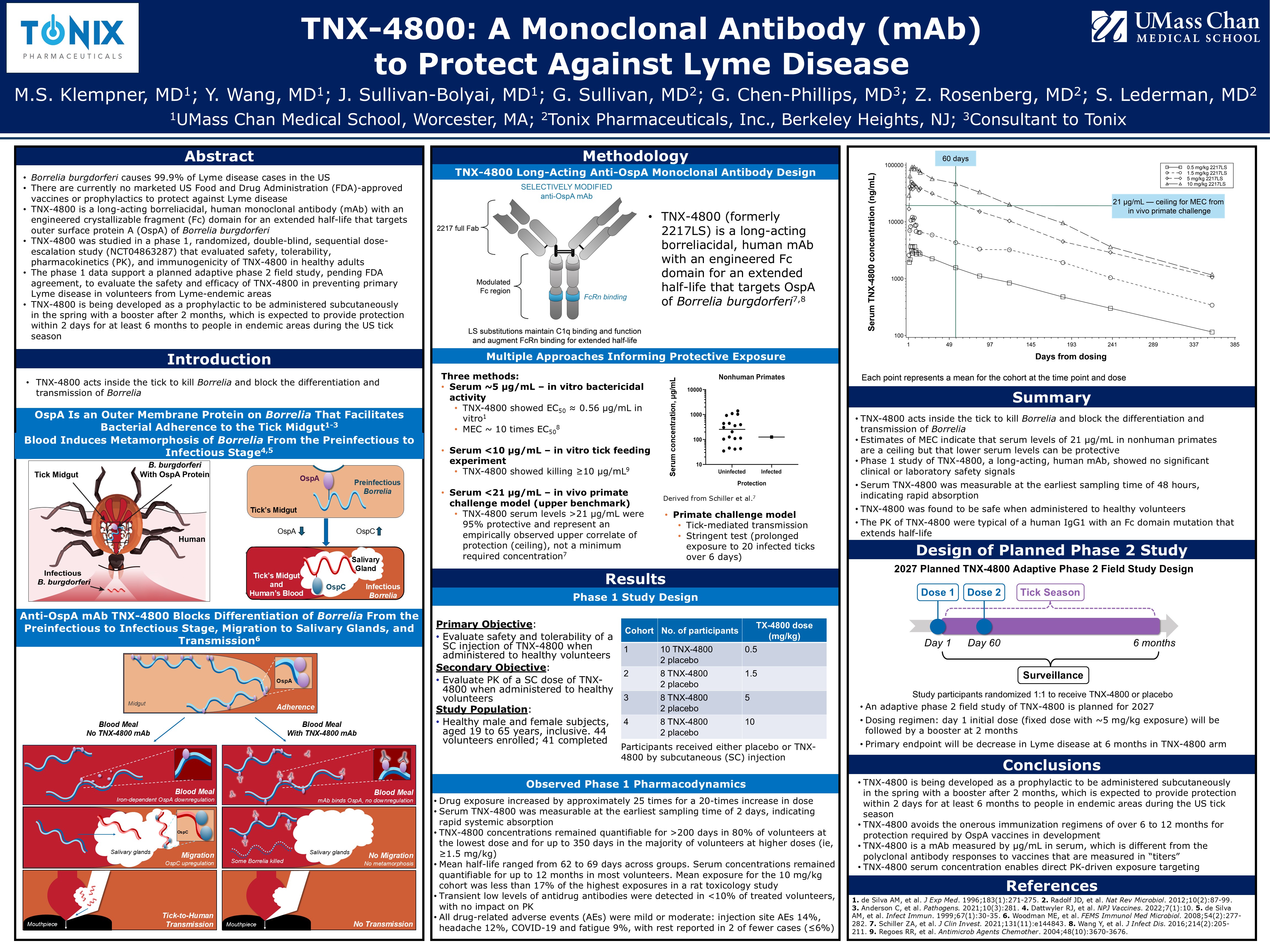
Serum concentration, µg/mL Observed Phase 1 Pharmacodynamics Study participants randomized 1:1 to receive TNX - 4800 or placebo Dose 1 Tick Season Day 1 Day 60 6 months 2027 Planned TNX - 4800 Adaptive Phase 2 Field Study Design Dose 2 Surveillance Summary Conclusions Results References Design of Planned Phase 2 Study Multiple Approaches Informing Protective Exposure TNX - 4800 Long - Acting Anti - OspA Monoclonal Antibody Design Methodology Phase 1 Study Design Anti - OspA mAb TNX - 4800 Blocks Differentiation of Borrelia From the Preinfectious to Infectious Stage, Migration to Salivary Glands, and Transmission 6 OspA Is an Outer Membrane Protein on Borrelia That Facilitates Bacterial Adherence to the Tick Midgut 1 - 3 TNX - 4800: A Monoclonal Antibody ( mAb ) to Protect Against Lyme Disease M.S. Klempner, MD 1 ; Y. Wang, MD 1 ; J. Sullivan - Bolyai, MD 1 ; G. Sullivan, MD 2 ; G. Chen - Phillips, MD 3 ; Z. Rosenberg, MD 2 ; S. Lederman, MD 2 • Borrelia burgdorferi causes 99.9% of Lyme disease cases in the US • There are currently no marketed US Food and Drug Administration (FDA) - approved vaccines or prophylactics to protect against Lyme disease • TNX - 4800 is a long - acting borreliacidal, human monoclonal antibody ( mAb ) with an engineered crystallizable fragment (Fc) domain for an extended half - life that targets outer surface protein A ( OspA ) of Borrelia burgdorferi • TNX - 4800 was studied in a phase 1, randomized, double - blind, sequential dose - escalation study (NCT04863287) that evaluated safety, tolerability, pharmacokinetics (PK), and immunogenicity of TNX - 4800 in healthy adults • The phase 1 data support a planned adaptive phase 2 field study, pending FDA agreement, to evaluate the safety and efficacy of TNX - 4800 in preventing primary Lyme disease in volunteers from Lyme - endemic areas • TNX - 4800 is being developed as a prophylactic to be administered subcutaneously in the spring with a booster after 2 months, which is expected to provide protection within 2 days for at least 6 months to people in endemic areas during the US tick season Abstract Introduction • Drug exposure increased by approximately 25 times for a 20 - times increase in dose • Serum TNX - 4800 was measurable at the earliest sampling time of 2 days, indicating rapid systemic absorption • TNX - 4800 concentrations remained quantifiable for >200 days in 80% of volunteers at the lowest dose and for up to 350 days in the majority of volunteers at higher doses ( ie , ≥1.5 mg/kg) • Mean half - life ranged from 62 t o 69 days across groups. Serum concentrations remained quantifiable for up to 12 months in most volunteers. Mean exposure for the 10 mg/kg cohort was less than 17% of the highest exposures in a rat toxicology study • Transient low levels of antidrug antibodies were detected in <10% of treated volunteers, with no impact on PK • All drug - related adverse events (AEs) were mild or moderate: injection site AEs 14%, headache 12%, COVID - 19 and fatigue 9%, with rest reported in 2 of fewer cases (≤6%) • TNX - 4800 acts inside the tick to kill Borrelia and block the differentiation and transmission of Borrelia • Estimates of MEC indicate that serum levels of 21 μ g/mL in nonhuman primates are a ceiling but that lower serum levels can be protective • Phase 1 study of TNX - 4800, a long - acting, human mAb , showed no significant clinical or laboratory safety signals • Serum TNX - 4800 was measurable at the earliest sampling time of 48 hours, indicating rapid absorption • TNX - 4800 was found to be safe when administered to healthy volunteers • The PK of TNX - 4800 were typical of a human IgG1 with an Fc domain mutation that extends half - life 1 UMass Chan Medical School, Worcester, MA; 2 Tonix Pharmaceuticals, Inc., Berkeley Heights, NJ; 3 Consultant to Tonix Primary Objective : • Evaluate safety and tolerability of a SC injection of TNX - 4800 when administered to healthy volunteers Secondary Objective : • Evaluate PK of a SC dose of TNX - 4800 when administered to healthy volunteers Study Population : • Healthy male and female subjects, aged 19 to 65 years, inclusive. 44 volunteers enrolled; 41 completed 1. de Silva AM, et al. J Exp Med . 1996;183(1):271 - 275. 2. Radolf JD, et al. Nat Rev Microbiol . 2012;10(2):87 - 99. 3. Anderson C, et al. Pathogens. 2021;10(3):281. 4. Dattwyler RJ, et al. NPJ Vaccines . 2022;7(1):10. 5. de Silva AM, et al. Infect Immun . 1999;67(1):30 - 35. 6. Woodman ME, et al. FEMS Immunol Med Microbiol . 2008;54(2):277 - 282. 7. Schiller ZA, et al. J Clin Invest. 2021;131(11):e144843. 8. Wang Y, et al. J Infect Dis. 2016;214(2):205 - 211. 9. Regoes RR, et al. Antimicrob Agents Chemother . 2004;48(10):3670 - 3676. Transmission Adherence Midgut OspA Some Borrelia killed Blood Meal No TNX - 4800 mAb Blood Meal With TNX - 4800 mAb Migration Blood Meal mAb binds OspA , no downregulation No Transmission Mouthpiece Salivary glands No Migration No metamorphosis Some Borrelia killed Migration Blood Meal Iron - dependent OspA downregulation Mouthpiece Salivary glands OspC Migration OspC upregulation Tick - to - Human Transmission TX - 4800 dose (mg/kg) No. of participants Cohort 0.5 10 TNX - 4800 2 placebo 1 1.5 8 TNX - 4800 2 placebo 2 5 8 TNX - 4800 2 placebo 3 10 8 TNX - 4800 2 placebo 4 Participants received either placebo or TNX - 4800 by subcutaneous (SC) injection OspC OspA • TNX - 4800 (formerly 2217LS) is a long - acting borreliacidal, human mAb with an engineered Fc domain for an extended half - life that targets OspA of Borrelia burgdorferi 7,8 • TNX - 4800 is being developed as a prophylactic to be administered subcutaneously in the spring with a booster after 2 months, which is expected to provide protection within 2 days for at least 6 months to people in endemic areas during the US tick season • TNX - 4800 avoids the onerous immunization regimens of over 6 to 12 months for protection required by OspA vaccines in development • TNX - 4800 is a mAb measured by μ g/mL in serum, which is different from the polyclonal antibody responses to vaccines that are measured in “titers” • TNX - 4800 serum concentration enables direct PK - driven exposure targeting Three methods: • Serum ~ 5 μ g/mL – in vitro bactericidal activity • TNX - 4800 showed EC 50 ≈ 0.56 μ g/mL in vitro 1 • MEC ~ 10 times EC 50 8 • Serum <10 μ g/mL – in vitro tick feeding experiment • TNX - 4800 showed killing ≥10 μ g/mL 9 • Serum <21 μ g/mL – in vivo primate challenge model (upper benchmark) • TNX - 4800 serum levels >21 μ g/mL were 95% protective and represent an empirically observed upper correlate of protection (ceiling), not a minimum required concentration 7 Derived from Schiller et al. 7 • An adaptive phase 2 field study of TNX - 4800 is planned for 2027 • Dosing regimen: day 1 initial dose (fixed dose with ~5 mg/kg exposure) will be followed by a booster at 2 months • Primary endpoint will be decrease in Lyme disease at 6 months in TNX - 4800 arm • TNX - 4800 acts inside the tick to kill Borrelia and block the differentiation and transmission of Borrelia • Primate challenge model • Tick - mediated transmission • Stringent test (prolonged exposure to 20 infected ticks over 6 days) Preinfectious Borrelia Tick’s Midgut OspA Infectious Borrelia Tick’s Midgut and Human’s Blood Salivary Gland OspC Blood Induces Metamorphosis of Borrelia From the Preinfectious to Infectious Stage 4,5